
Study Abroad Spotlight on Egyptian Art: Ancient, Islamic, Modern

Rutgers Global offered a new faculty-led study abroad program this winter called Egyptian Art: Ancient, Islamic, and Modern. This short-term program took place between semesters in January and was led by Rutgers-Newark faculty member Professor Alex Seggerman as part of a course she taught in the fall. The on-campus course covered the history of art in Egypt, including ancient sphinxes, Coptic textiles, medieval Islamic mosques, modern urban developments, and the contemporary graffiti of the Arab Spring. In addition, there was a focus on how art and cultural heritage have been preserved and presented in museums, and students had the opportunity to visit the Newark Museum of Art and the Metropolitan Museum of Art to view how Egyptian art is categorized and displayed in the United States.
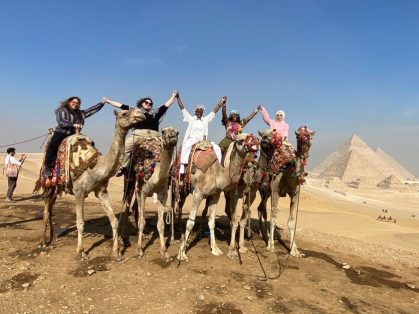
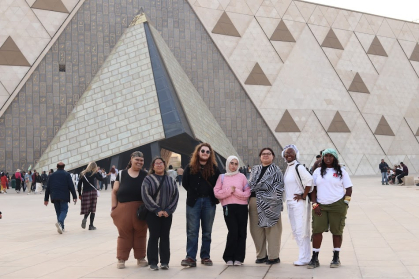
In January 2026, the students traveled to Egypt for ten days, staying in Cairo with a day trip to Alexandria, and visited ancient sites including the Pyramids of Giza and the King Tut treasures at the new Grand Egyptian Museum, as well as other heritage sites with diverse religious backgrounds like the Ben Ezra Synagogue, the Coptic Hanging Church, and Ibn Tulun Mosque. There were also opportunities to visit modern art museums and meet with contemporary working artists.
The aim of the experiential aspect of the course was to expose students to Egyptian culture, the Arabic language, and the diverse ways in which museums are crafted and maintained outside the United States.
Rutgers Global is grateful to the Mad Rose Foundation and the Rutgers Center for African Studies for their support of this program through the Access Africa initiative. The flights for the students participating in Egyptian Art: Ancient, Islamic, and Modern were fully subsidized.
We talked with Professor Seggerman and some of her students to learn more about the course.
Q&A with Faculty Lead Alex Dika Seggerman
Professor Seggerman, PhD, is Associate Professor of Art History in the Department of Arts, Culture and Media at Rutgers University-Newark. She is an art historian who specializes in Islamic art and modern art history. Her first book, Modernism on the Nile, was based on extensive research in Cairo. She is also the co-editor of Making Modernity.
What inspired you to create this program?
My scholarly art history research since 2008 has focused on Egypt, and in 2019 I published a book about modern Egyptian art called Modernism on the Nile. I lived in Cairo during my doctoral fieldwork and have visited many times for my own projects. In addition to being very familiar with the museums and historical sites of Cairo, I also know many wonderful people in Cairo in the arts, museums, libraries, and universities. It just felt like the right moment to share this knowledge with and connect these people to my Rutgers students.
Was the experience what you were expecting?
The experience was so much more wonderful than I was expecting. I was beyond impressed with the unflappability, enthusiasm, critical thinking, and joy of the 8 Rutgers students who attended the trip. It was a physically taxing journey, yet each of them whole heartedly opened themselves up to Egyptian history, culture, people, and food. It was of course delightful to be in sunny and warm Cairo instead of blizzarding New Jersey!
How did your students respond?
The students thoroughly enjoyed the museums, activities, and meals. They thoughtfully engaged with everything we saw from ancient artifacts to contemporary artists, and they especially loved shopping in the many handicraft shops. They really bonded with our great tour guide, Sameh, who they called ‘Dad.’ On our second to last day, we visited a very windy Alexandria. On the coastline promenade, they faced a choppy wave that crashed against the rocks, spraying us all with salty Mediterranean Sea. They smiled and laughed, and this encapsulates how they tenaciously approached the whole trip, with joy and wonder.
What was the most impressive thing about the new Grand Egyptian Museum?
The new museum is truly stunning, and hard to describe in a way that conveys its grandeur and immensity. The interior artium is immense and beautifully designed, centered around a monumental 36-foot Ramses II statue. The king Tutankhamen treasures have been installed in this new space in a breathtaking way. The sheer level of gold will knock your socks off.
Are you planning to run this program again?
YES! I am planning to run the embedded program again with a course in Fall 2026 and the trip again January 2027.
Student Reflections from Ream Elkawaga, Ashley Vargas, and Gabi Figueroa:
“As a member of the Egyptian diaspora, being able to return home to Egypt was a gift I can never truly capture in words. Every step of our journey was riddled with such genuine fun and love, connecting me back to my country in ways I never thought possible. I grew to appreciate the never-ending beeping cars, the various nostalgic smells, the taste of home-cooked meals, the witnessing of such vibrant history, and the sensation of being embraced into a hug by the very land itself. I saw Egypt in her crisp prime with her shiny new museums harboring thousands upon thousands of ancient artifacts that we simply could not fully witness in full. But we also saw her in the now, her uneven streets and curious cats running through the stairwells of renovated buildings and beautiful art galleries.
I remember one of our earlier trips, riding a felucca along the Nile with my dear friends, our professor, our tour guide and even our bodyguard that we had befriended. We had visited the Tahrir Egyptian museum earlier in the day, then went along to visit the American Research Center in Egypt and walked through its library. A day filled with admiring the past, gently ended with all of us enjoying the lulling rocking of the sailboat. The Nile itself is ancient, the very source of Egypt’s livelihood, and there we were relaxing as we chatted about our day. I had asked our tour guide, Sameh, if it would be alright to have another quick turn around the Nile. He agreed and asked the sailor, filling me with comfort.
The thing is, the sweetness of Egypt does not just lie in its history and land, but also the kindness and resilience of its people. In every place we visited, we met someone passionate, a smile always gracing their face. Egypt welcomed me back, and her people also opened their arms to everyone who wished to truly learn about her. I remember the sun setting as we ended our felucca ride, its light glittering along the Nile, as if echoing the long-held sentiment that it will rise once more to welcome us here whenever we return.”
-Ream Elkawaga
“I found Cairo not in the shadows of his ancient wonders, but in the small alleyways between the Old and the New. I came looking not for the answers he gives, but for the questions he forces me to ask. He breathes through exhaust and incense—a scent that clung to my hair every morning. Sitting on a curb in Zamalek, you find that he is a work of both breath and grit. He is an old man sitting on a plastic chair, much like the one I’d imagined. He didn't speak my language, but as he handed me a glass of hibiscus tea, his eyes—fixed on the swirl of Vespas and vendors—seemed to hold the same centuries-old patience I’d read about. You start hearing his voice in the sounds of the city, from the call to prayer for fajr to ordering koshary for the friends you’ve made. In that moment, he stopped being a map of landmarks and became a person I was finally sitting beside. Cairo doesn’t just exist to be looked at; he exists to be lived.”
-Ashley Vargas
“Egypt was an absolute dream come true. It was rich with historical buildings that we explored thoroughly. We had the opportunity to visit different museums, art galleries, and landmarks, including the pyramids. The pyramids were beyond incredible up close. As an ancient burial site, the energy alone around the pyramids was indescribable. The significance of where we were standing was palpable. It was truly an honor to get to experience walking through the different eras of Egypt in person. Most people dream about visiting Egypt, and I somehow got to experience Egypt as a sophomore, with most expenses paid by Rutgers and Access Africa.
We were walking over 10k steps a day while being up from about 5 am to 7 pm. I was able to keep up and enjoy all the activities, which made me full to the brim with pride. The confidence that I have gained in myself has been immeasurable. It's one thing to be in a familiar environment such as the United States, doing heavy activity, because in America, things are much easier to traverse. Egypt was not as developed, so having the stamina and strength to keep up allowed me to truly internalize that nothing is outside of my reach. In general, I love to travel but this study abroad experience ignited an almost insatiable desire to continue to tackle all the limiting beliefs I held about myself and relentlessly pursue my passion for adventure. I am continuing my abroad streak this semester in Jordan, and I cannot wait to see yet another world wonder- Petra!
From someone who was temporarily disabled and knocking at death’s door, to traveling the world as a student who consecutively made the dean’s list since returning to Rutgers after 6 years, I don't think there are enough positive words for how grateful I am for not just Egypt but the opportunity to study abroad overall. I plan to return to study abroad in Egypt for the Fall 2026 semester because I adored my time there so much that I want to continue to immerse myself in its wonderful culture.”
-Gabi Figueroa
Applications for the 2027 study abroad program Egyptian Art: Ancient, Islamic, and Modern are open right now with an application deadline on August 1. As before, participating students’ flights will be full subsidized through the Access Africa initiative. Apply now!
Learn more about all of our study abroad programs on our website.


