
Embedded Fall: Rutgers-Egyptian Art: Ancient, Islamic, and Modern
The Program
“Man fears time, but time fears the pyramids”
– Arab proverb
The on-campus course will cover the history of art in Egypt, including ancient sphinxes, Coptic textiles, medieval Islamic mosques, modern urban developments, and the contemporary graffiti of the Arab Spring. We will focus on how art and cultural heritage have been preserved and presented in museums. Students will visit the Newark Museum of Art and the Metropolitan Museum of Art to view how Egyptian art is categorized and displayed in the United States.
In January 2027, we will travel to Egypt for 10 days weeks, staying in Cairo with a day trip to Alexandria. Students will visit world famous ancient sites like the Pyramids of Giza and the King Tut treasures at the brand new Grand Egyptian Museum, as well as other heritage sites with diverse religious backgrounds like the Ben Ezra Synagogue, the Coptic Hanging Church, and Ibn Tulun Mosque. We will also visit modern art museums and meet with contemporary working artists. This experiential aspect of the course will expose students to Egyptian culture, the Arabic language, and the diverse ways in which museums are crafted and maintained outside the United States.
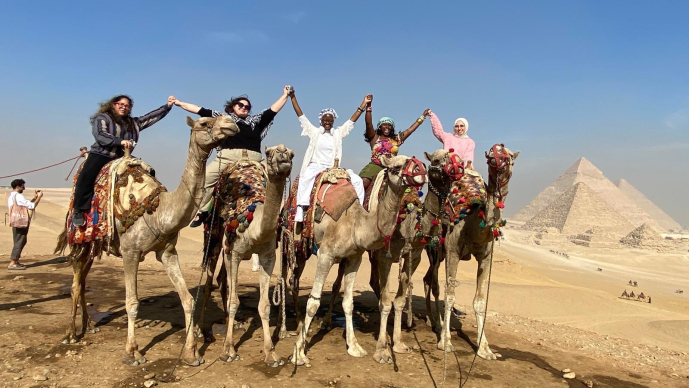
Program Locations
Egypt
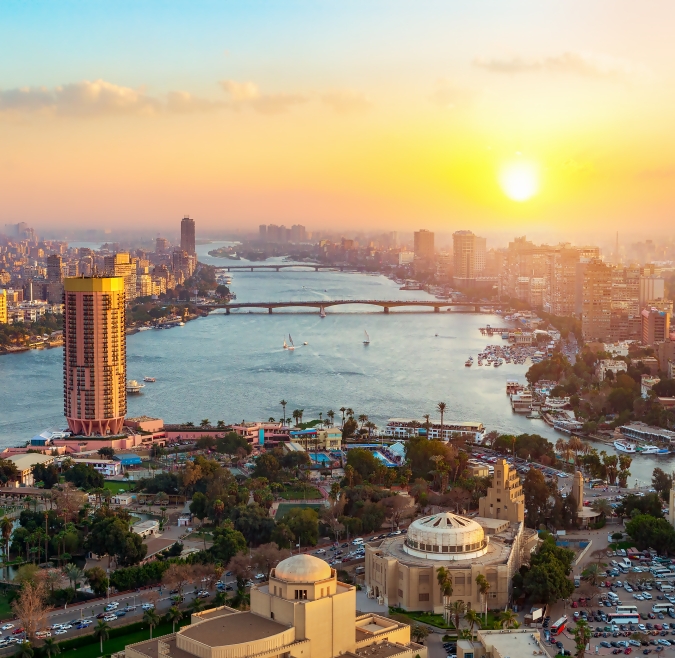
Cairo
Cairo: Egypt’s capital and one of Africa’s largest cities, Cairo sits on the banks of the Nile River. From the Ancient Giza Pyramids to the Mamluk Sultan Hassan Mosque to contemporary art galleries near Tahrir Square, its rich history spans millennia.

Egypt
Alexandria
This pictures shows the Citadel of Qaitbay in Alexandria, Egypt: A historical maritime fortress, echoing the architectural legacy and coastal defense of ancient times.
Academics
The Fall course, required as a pre-requisite for the January trip, will fulfill Rutgers-Newark students’ Arts & Media core requirement. The class will also count towards the major or minor in Fine Arts or Art History, as well as towards the minor in Middle East and Islamic Studies.
Students will enroll in the 3-credit course Egyptian Art: Ancient, Islamic, and Modern (21:082:305) during the Fall 2026 semester. The class will meet on Newark Campus, Monday and Wednesday 10:00am-11:20am
Housing and Meals
Students will stay in comfortable, centrally-located, and Wi-Fi-equipped Flamenco hotel in shared rooms. Most meals are included in the course fee, as are a number of cultural activities.
Financial Information
Program Costs
| All Students | |
|---|---|
| Program Cost | $3,600 |
Program Cost includes:
- Housing
- Airfare
- Some meals
- In-country transportation
- Excursions and cultural visits
- Administrative Fees
- Emergency Medical Access Abroad
Out-of-Pocket Costs
| Airfare | Covered by the MadRose Foundation |
| Meals not included | $200 |
| Visas | $25 |
| Personal Expenses | $200 |
| Total | $425.00 |
Out-of-Pocket Cost includes:
The above costs are estimations and represent the known out-of-pocket costs students encounter during their time abroad.
Some of these expenses will be paid for prior to going abroad, such as an airline ticket, while some of these expenses, such as meals and personal expenses, will be paid in-country as part of your daily expenses. As you plan, you will need to budget these costs and spend wisely throughout your time abroad.
Airfare has been subsidized by the MadRose Foundation and Access Africa Initiative. Because Access Africa is designed to broaden participation in study abroad, priority is given to students who have not previously received an Access Africa scholarship. Previous recipients may not be eligible for additional Access Africa funding.
Scholarships
Faculty Leaders

Prof. Seggerman is an art historian who specializes in Islamic art and modern art history. Her first book, Modernism on the Nile, was based on extensive research in Cairo. Email Prof. Seggerman at alex.seggerman@rutgers.edu

As an Egyptian, I had spent a very long time away from home. I dreamt of returning but there was always something that came in the way. Yet, once I saw the poster for the Egypt trip with Professor Seggerman, I knew I had to take this chance. I honestly can not fully describe in words just how impactful this trip was on me. Not only did I get to see my family and country again, but I made such wonderful memories with the friends I made during this course and trip. The embedded portion of the course allowed me to really bond with everyone as we worked on our projects, completed our assignments, and went on class trips together. Memorably, the time we visited the MET for a guided tour only to be rained on the entire way there. Funnily enough, it rained on our day trip to Alexandria. However, this time we were smiling in the face of the turbulent weather, bursting into a cheerful laughter as we all loudly prayed for a wave to splash us (it did!). I got to truly be myself in Egypt, reconnecting with my language, being the go-to honorary guide and translator for my friends and wonderful professor, and really being in my element. When we visited art galleries in Zamalek, I was lucky enough to get to speak with one of the artists and further explain his works and intentions to my friends. Or when we were on the felucca ride, and I asked for just another spin around the Nile. It felt wonderful getting to learn about the art and rich history of my country, while still just enjoying the mundane pleasures of talking to a local. This trip was absolutely unforgettable, and the knowledge, experiences, and friendships I made during it will always be with me.