UN @ Rutgers: Spotlight on Manuela Gomez
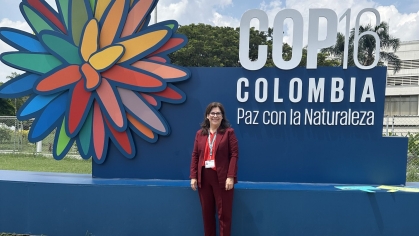
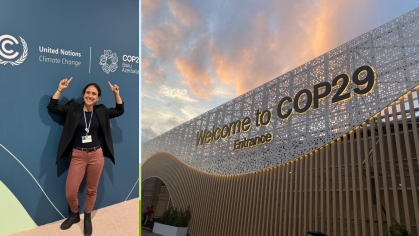
Manuela Gomez, a recent graduate of the M.A. program in Peace and Conflict Studies and an alumna of the Political Science program at Rutgers University–Newark, is forging a powerful path in international relations; one rooted in personal experience, global engagement, and a steadfast commitment to sustainable peace.
Originally from Colombia, Manuela grew up amid decades of armed conflict, witnessing the profound toll violence takes on communities and individuals. Those realities sparked her early interest in peacebuilding and motivated her to pursue academic work that could help illuminate global pathways to conflict resolution. When she moved to the United States to continue her studies at Rutgers–Newark, she did so with a clear intention: to better understand how other countries confront and recover from the types of struggles long faced in Colombia.
Her purpose, she explains, was to “step out of the bubble of indifference and learn from other countries that have lived, or are living, situations similar to those we experience in Colombia.”
A Global Perspective in the Making
While completing her undergraduate degree, Manuela was nominated—along with five other Rutgers students—to represent the University at the Global Peace Summit held at the United Nations in Bangkok, Thailand. The conference convened more than 370 emerging leaders for in-depth dialogues with refugees, peace ambassadors, conflict survivors, and government officials.
“The conference took place in January 2024, only three months after the conflict in Gaza escalated,” she recalls. “I remember one panel with a Palestinian ambassador, a Holocaust survivor, Jewish students, and refugees from different countries. It was tense, and it was the moment I realized how challenging it is to engage meaningfully in international relations. It opened my eyes to global realities and made me want to meet, firsthand, the people living them.”
That experience shifted her trajectory. Determined to gain a deeper understanding of international development and human rights, Manuela interned at USAID in the Democracy, Human Rights, and Governance Bureau, where she explored how U.S. funding shapes governance, freedom, and prosperity in developing nations.
Learning from Refugee Realities in Kenya
Still, she felt compelled to move beyond reports and policy documents and witness the conditions of conflict-affected communities directly. This drive led her to join the Rutgers summer study abroad program Learning from Refugee Experiences in East Africa.
In Kenya, Manuela visited Kakuma Refugee Camp, one of Africa’s largest, home to more than 200,000 refugees.
“This experience changed both my personal and professional life,” she says. “Seeing the poverty and vulnerability in which refugees live was critical. But what impacted me the most was realizing how limited their opportunities are simply because they are stateless. They do not have IDs, cannot legally work, and depend entirely on international donors. They live not only with their daily hardships, but also with the pain of their past—the situations they fled, and the loved ones they left behind.”
The lessons she carried from Kakuma strengthened her resolve to work alongside communities affected by violence and displacement, and to contribute to long-term solutions that promote peace and dignity.
Representing Youth Voices at the United Nations
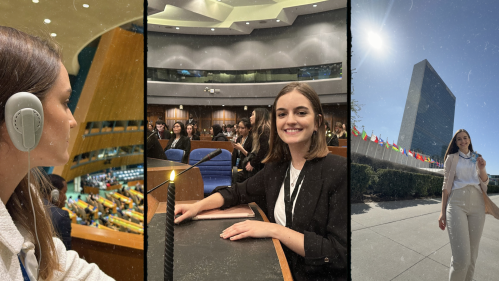
With a growing focus on diplomacy and international cooperation, Manuela sought opportunities to engage at the highest levels. In January 2025, she was selected to serve as a United Nations Youth Representative for NAFSA: Association of International Educators.
In this role, she participates in civil society and NGO forums, advocates for international education and mobility, and engages with global leaders on the world stage. She also attended the 2025 UN General Assembly. “Listening firsthand to leaders such as Emmanuel Macron, Benjamin Netanyahu, Gustavo Petro, and Michelle Bachelet was impactful,” she explains. “It reinforced the importance of dialogue, and the immense challenges leaders face in pursuing peace.”
Expanding Her Global Lens in South Africa
Manuela’s most recent academic journey took her to South Africa through the Summer South Africa Initiative. There, she explored a nation still working through the legacies of apartheid.
“Visiting museums that recount the history of apartheid, and the role of Nelson Mandela was very insightful,” she says. “But what I value most was the opportunity to interact with vulnerable communities, NGOs, university students, and faculty. Understanding apartheid from multiple perspectives was crucial—and profoundly meaningful.”
Looking Ahead: A Commitment to Sustainable Peace
Today, Manuela continues to build a career shaped by her experiences across three continents and by her deep commitment to conflict-affected communities. Her goal is clear: to return to Colombia with a breadth of global insight that will allow her to help construct lasting, inclusive peace.
Johanna Bernstein, Assistant Dean for Faculty Engagement, and lead on the UN @ Rutgers Initiative, notes, “Manuela’s story is a powerful example of how Rutgers students engage with the world—not only as learners, but as leaders dedicated to creating a more just and peaceful future.”
For more about UN @ Rutgers, visit: https://global.rutgers.edu/un-engagement