

Summer: Rutgers-Discovering Nature and Community in Puerto Rico, The Rio Piedras Watershed
The Program
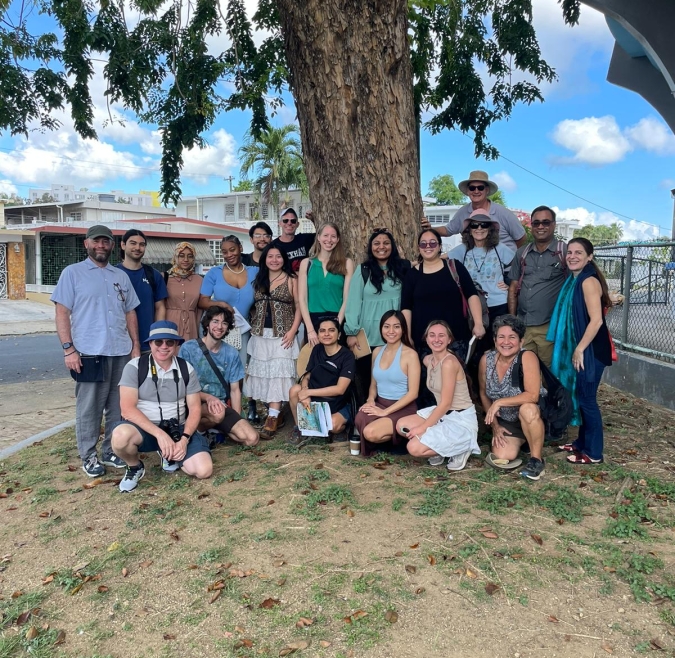
The program immerses students in the experience of city, nature, people and, culture.
The Rio Piedras watershed is a vital natural resource and plays a critical role in the environmental health and sustainability of the San Juan metropolitan area. Stewardship of the watershed involves a combination of engagement, experiential learning, conservation practices, and urban planning and design.

Program Locations
Puerto Rico
Rio Piedras
In the three-week part of the program on the Island students will work with local organizations, academics, professionals and community residents to learn about and travel the Rio Piedras watershed, open space planning and design, and the general history and history of water works on the island. Municipalities visited include Aguadilla, Mayaguez, Ponce, Utuado and Rio Grande.
Academics
The six credit program goals, objectives and outcomes are equivalent to landscape architecture, urban design, architecture and art studios or two environmental policy, environmental sciences, ecology or geography courses.
The Rio Piedras watershed is a vital natural resource and plays a critical role in the environmental health and sustainability of the San Juan metropolitan area. Efforts to protect and manage the watershed involve a combination of conservation practices, and urban planning initiatives. These efforts intersect with components that are often not totally accounted for in the conservation and design process. Social and environmental justice, environmental policy and regulations, economic and historic components, community needs and concerns are often not considered to their full extent in the design process.
Course Goals
1. Develop skills to interpret science, technology, and cultural context to propose innovative solutions in sustainability, land stewardship, and other contemporary urban challenges.
2. To acquire professional abilities with ethical, technical, and industry standards to foster social well-being through safe, accessible, and healthy environments.
3. To explore how to creatively document space and social/spatial relationships.
Learning Objectives
1. Learn the social aspects of resilient design through engagement of community, socially engaged researchers and community design practitioners.
2. Learn the theories and methods of site and place documentation and processes to develop plans and physical design form.
3. Learn to synthesize analyses to propose ideas that address climate change and inform agencies, groups and individuals engaged in climate and social change issues.
Students will engage and interact with students from the Polytechnic University of Puerto Rico (Landscape Architecture, Architecture and Civil Engineering Departments), El Estuario and Guarda Rios organizations for days of service, and several island scientists, environmentalists, landscape architects and engineers. They will also travel to 3 areas on the island as day trips.
The program is deeply experiential with structured documentation methods (drawing, journaling, photos, videos, writing and reporting) to provide students with human and environmental engagement. The deliverables will be assessed on goal and objectives-based rubrics
Housing and Meals
Students will share rooms on university property or a hostel. We will make arrangements for breakfast.
Scholarships
Available to all Rutgers students participating in a Rutgers Global–Study Abroad program. Applications can be found inside of your study abroad program application. For more information, please visit the Scholarship section of our website.
Available to study abroad students who receive a Pell Grant. For more information about the scholarship and additional eligibility requirements please visit the Gilman website.
All SEBS students are eligible for the OGE  Scholarship to support study abroad in the sciences. Students must apply or have been accepted to an eligible science-based program or have completed an independent study evaluation (215k PDF) with a faculty member. The scholarship will cover up to half of the program fee for short-term summer, winter, and spring break programs and does not include non-billable items such as flights, ground transportation, and academic supplies.
Faculty Leaders

Richard Alomar is Chair and Graduate Program Director of the department of Landscape Architecture, Director of the Office of Urban Extension and Engagement, and Associate Professor of Landscape Architecture at Rutgers University; An ASLA Fellow, a registered landscape architect and former chair of Landscape Architecture of the New York State Board of the Professions.
He has an undergraduate degree in Agronomy from the University of Puerto Rico at Mayaguez and an MLA from Louisiana State University. Before joining Rutgers, he was an Associate at Stantec Planning and Landscape Architecture, Senior Associate at di Domenico + Partners and a guest instructor at Columbia University. He has worked on public projects from urban planning to the community garden scale and has won international competitions in landscape design, architecture, and planning.
At the Office of Urban Extension and Engagement, Alomar’s role is to raise the visibility of the New Jersey Agriculture and Experiment Station and School of Environmental and Biological Science’s expertise and resources to address issues affecting urban residents and their communities, specifically, food security, individual and community health, resource stewardship, urban agriculture and food chains, and environmental planning and design.